

Sarasvati’s association with rivers diminishes in later texts, highlighting the evolving role of Goddess Sarasvati in Hinduism. While some late sources still link her to rivers, she increasingly differs from a river goddess in both characteristics and appearance.
Identification with Vagdevi
In the Brahmanas, Hindu tradition consistently identifies Sarasvati with Vagdevi, the goddess of speech. The precise connection between Sarasvati and Vagdevi remains unclear. Perhaps it stemmed from the centrality of sacred speech in Vedic rituals conducted on the banks of the Sarasvati River. Sarasvati gradually becomes associated with speech, learning, culture, and wisdom. Post-Vedic references rarely mention her earlier identity as a river goddess.
Mythological Origins
Later Hindu texts describe Sarasvati as emerging from Brahma himself. Desiring creation, Brahma meditates, his body splitting into male and female halves. Enamored by his female half, Sarasvati, Brahma desires her. They unite, and from this union, the demigod Manu emerges, who then creates the world. Similar accounts appear in the Brahma-vaivarta Purana and the Devi-bhagavata Purana, where Krishna, identified with absolute reality (Brahman), divides into male (Purusha) and female (Prakriti) aspects for creation. Sarasvati, one of his five saktis (dynamic powers), embodies insight, knowledge, and learning. Some texts describe Sarasvati emerging from the tip of Krishna’s Sakti’s tongue. She appears as a lovely girl adorned in yellow garments, jewels, and holding a book and vina (lute). Other sources link her origin to Brahma’s mouths—he has four or five heads—where she manifests during the world’s creation through divine speech.
Association with Vishnu and Lakshmi
Sacred literature also closely associates Sarasvati with Vishnu. Some texts describe her as Vishnu’s tongue or as dwelling within his mouth, emphasizing her role as the cosmic principle of speech and expression. This association makes her Lakshmi’s co-wife in many myths. Sarasvati represents spiritual, ascetic, or religious pursuits, contrasting with Lakshmi’s embodiment of worldly well-being, wealth, power, and fertility. Other accounts depict tension between two goddesses, reflecting a conflict in Hinduism between sensual enjoyment (bhukti) or dharma and spiritual liberation (mukti).
Retaining Earlier Characteristics
Despite Sarasvati’s transformation in later Hinduism away from her river goddess origins, she retains some earlier characteristics. Mythological sources further connect Sarasvati with natural phenomena such as clouds, thunder, and rain. Many traditions regard her as the presiding deity of rainfall. The Vamana Purana describes her movement through clouds, where she generates rain, and identifies her with all forms of water. Sarasvati’s link with Soma and water suggests her role in nourishing life and promoting fertility. Although she is no longer solely a river goddess, Sarasvati pervades creation through life-giving and purifying water forms such as rain, rivers, and ponds.
Predominant Association with Speech
In later tradition, Sarasvati’s predominant association is with speech. The Rig Veda praises Sarasvati as the inspirer of truthful and melodious speech and as the force that awakens noble and elevated thoughts. Epithets like Vagdevi (goddess of speech), Jihvagravasini (dwelling on the tongue’s front), Kavijihvagravasini (dwelling on poets’ tongues), Sabdavasini (dwelling in sound), Vagisvari (mistress of speech), and Mahavani (possessing great speech) underscore her connection to speech and creative sound. Speech holds profound importance in Hinduism, encapsulated in the syllable ‘om’ and the concept of creation arising from sabda-brahman (ultimate reality as sound). Vedic tradition reveres mantras—sacred words and sounds—for their immense spiritual power, equating the correct utterance of a mantra with the direct invocation of the deity itself.
Embodiment of Thought and Intellect
Moreover, Sarasvati embodies thought and intellect. She is not just coherent speech but also the intelligence and memory underlying speech. Epithets like Smrtisakti (power of memory), Jnatasakti (power of knowledge), Buddhisaktisvarupini (form of intellectual power), Kalpanasakti (power of imagination), and Pratibha (intelligence) highlight her association with human reasoning and creativity. Hindu philosophy honors Sarasvati as the patroness of science, learning, and knowledge, reinforcing her identity as the goddess of speech, intellect, and wisdom.
Cosmic Goddess
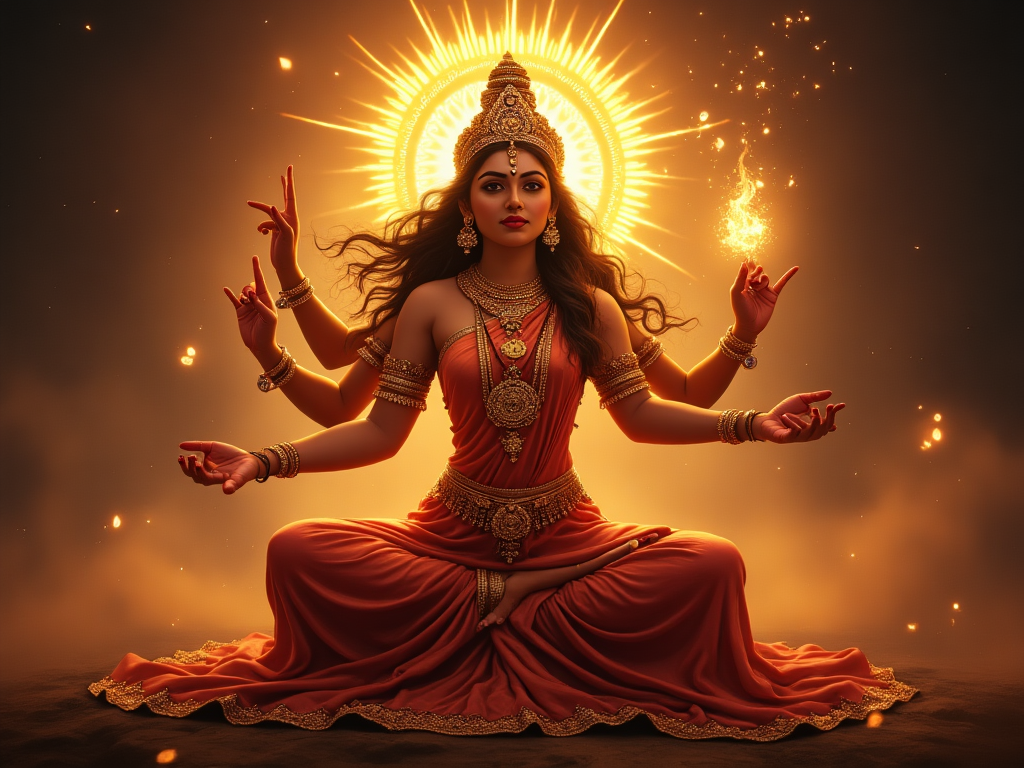
Beyond these cultural roles, tradition also venerates her as a cosmic goddess whose creative power extends to the formation of worlds. Titles like Jaganmata (mother of the world), Shakti Roopini (embodiment of power), and Visvarupa (containing all forms) elevate her status to encompassing cosmic powers. Her iconography depicts her with four hands, holding a book, lute (vina), rosary, and water pot, symbolizing her dominion over the arts, sciences, and spiritual knowledge.
Transcendental Nature
Her vehicle, the swan (hamsa), symbolizes spiritual discernment and transcendence, reflecting her elevated and universal nature. Her seated posture on a lotus further signifies her purity and detachment from the mundane world’s imperfections. She inspires humanity to rise above physical limitations through cultural creation, embodying ideals of beauty, grace, and intellectual refinement.
Worship and Festivals
Devotees worship Sarasvati, seeking blessings of eloquence, wisdom, poetic inspiration, artistic skill, and removal of speech defects. Although devotees believe she bestows wealth, longevity, and worldly pleasures, Sarasvati primarily nurtures the success of philosophers, scholars, and artists.Even today, people across North India celebrate the worship of Sarasvati in early spring, honoring her enduring presence as the divine source of knowledge, creativity, and enlightened speech. Schools and universities establish her images, and cultural programs honor her influence on learning and the arts.