

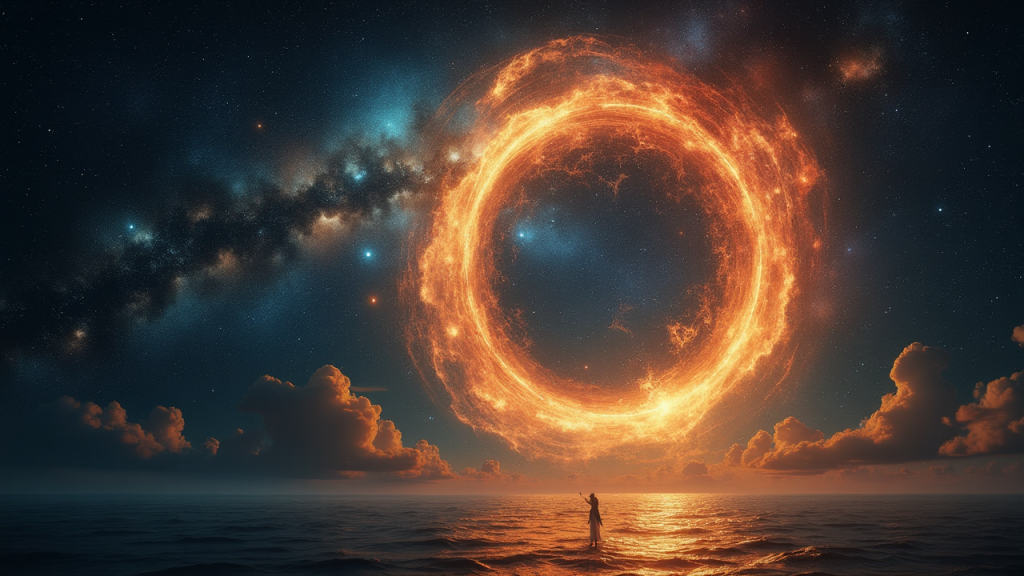
Placed under the whorled dust of innumerable feet of pilgrims and the chants of holy men is a conversation between stars and souls long past. Kumbh Mela is not a congregation; it is a dance of planets in the heavens, with their cosmology—the script written in the language of constellations. It reflects mankind’s ever-hungry thirst to encircle the divine. Let’s weave the entire cosmic cloth, one thread at a time.
1. The Celestial Clockwork: Why Timing is Everything
Imagine a heavenly council where Jupiter, Sun, and Moon debate the fate of millions. Every three years, planetary alignments open a door at one of India’s four sacred river junctions, summoning mankind to bathe in waters believed to turn into liquid light. But it’s not random mysticism—it’s precise astrology, the scientific art perfected over millennia. For those seeking guidance, astrology prediction online helps interpret these cosmic rhythms and their influence on human lives.
The Haridwar Aquarian Awakening:
When Jupiter enters the house of the Water-Bearer, and the Sun blazes in Aries, the Ganges River becomes such a conduit that even the ordained pilgrim wades through it during the time of Chaitra Amavasya, the moonless night of spring, believing that this moment condenses the cries of all into a thousandfold prayer.
Prayagraj Dusk of Capricorn:
Then Jupiter should meet the Sun-Moon duo in practical Capricorn during Makar Sankranti, when the aligned constellation stars in the sky are Ganges, Yamuna, and Saraswati, and make a whirlpool where the time seems to stand still.
Nashik’s Moonlight:
A full moon is between Cancer and Leo, with Jupiter shining from Leo. The river Godavari flows with maternal energy. During this period, devotees believe the Moon’s pull on Purnima charges the waters with emotional healing, washing away grief and fear.
Ujjain Scorpio Secrets:
When Jupiter balances in Libra and the Sun-Moon duo explores Scorpio’s mysteries, the Shipra River mirrors the cosmos. Scorpio’s association with death and rebirth transforms the ritual bath into a symbolic funeral for one’s past sins.
The same is true of the 12-year cycle with J. The symbol of grandeur in the sky is the Maha Kumbh, the event that occurs every 144 years. This moment marks the final encore, in which planetary cycles reestablish their initial positions, as if the cosmos held its breath and finally released it.
2. Myths as Cosmic Maps: The Battle That Never Ended
The origin of the Kumbh Mela is something more than a tale—but merely an echo of the stars. This *Samudra* *Manthan*, or churning of the ocean, describes the tussle between gods and demons over a pot (*kumbh*) of ambrosia. But astrologers see this as an analogy for the perpetual dance of light and shadows in our skies:
Jupiter-The Divine Advocate: In Vedic times, Jupiter (Guru) was the teacher of the gods, an ally of justice against greed, a force for upliftment upon the earth. When Jupiter, during Kumbh, aligns with various zodiac signs, he tilts the scales towards humanity and allows the divine nectar to drip into earthly rivers.
Rahu and Ketu—The Shadow Players: Demons who stole the nectar lost their heads. Their heads became Rahu, while the rest of their bodies became Ketu: celestial phantoms who still instigate eclipses. During Kumbh, their influence recedes, so devotees can bathe in eclipse-proof purity.
The Rivers as Cosmogonic Veins: For Hindus, these sacred rivers are nothing less than visible limbs of the Milky Way. When planetary activations occur, they become “star portals”, allowing for individual souls to merge with the galactic core. As a tribal sadhu once told me, “We’re not here to wash our bodies; we’re here to drown our stars.
III. The Alchemy of Faith: Where Science and Spirituality Collide
Yet, the Kumbh Mela for an outsider is chaos. For a believer, it is a quantum phenomenon—a place where collective intention engenders a bend in reality. Modern sociology calls this phenomenon “emergent spirituality”; astrologers call it the “Yoga of the Multitudes.
The Psychology of Auspicious Time: Timing astrological ritual baths down to the minute (*muhurta*) provides the necessary “spiritual algorithm.” Studies reveal that mass rituals (like chanting and bathing together) synchronise gamma brainwaves; a kind of “group mind” effect occurs. Pilgrims feel a sense of unity, and neuroscience shows their neurological rhythms synchronise.
Mercury Retrograde? Not This Time: While Westerners fear the worst during the transit of Mercury retrograde, the very participants in the Kumbh cherish the hard transits with opposite sentiments. Saturn’s harsh aspects in daily life act here as “cosmic exfoliation,” a tough peeler that scrubs karmic debts raw.
The Faith Equation: Astrophysicist Jayant Narlikar noted that Kumbh dates align with solar and lunar standstills, producing peaks in electromagnetic fields at the riverbanks. Whether by miracles or geophysics, the outcome is the same: at one moment, a human paralysed for years takes a step; an addict leaves his vice in the water.
4. Beyond Religion: The Kumbh as a Mirror of Modernity
Why is the Kumbh Mela becoming bigger even where AI and quantum computing have become, so to speak? Star charts and TikTok trends reveal the answers.
Astrology as a Rebellion: Pilgrim of the Gen-Z wears Nike shoes with rudraksha beads while posting selfies #BlessedByJupiter. For them, astrology is not dogma-it’s an objection to soulless algorithms; it’s a way of trying to reclaim some mystery in the data-driven world.
The TikTok Sadhus: Even hermits adapt. I met a young sadhu who livens up his Kumbh rituals into live streaming, saying the rules of “Venus in the 10th” pushed him to viral fame; after all,stars need to be relevant, in his words.
Climate Change & Cosmic Duty: Activists, with rivers drying up, are pushing the astrological pull of Kumbh to get the masses into environmentalism. “If Jupiter can bring them here, the same as a hundred million, it can also teach us to heal this earth,” says environmentalist Radha Bhatt.
5. Conclusion: Where the Zodiac Meets the Human Heart
The Kumbh Mela is much more than a pilgrimage. It is a living metaphor. Its astrological roots remind us that we are not merely on Earth, but of the cosmos, our lives inscribed in light-years and planetary cycles. Millions bathe together under a calculated sky, proving a truth: when belief aligns with the stars, it can shift mountains—and even galaxies.
The next Kumbh will find me here on those crowded banks-not for redemption, but just for rapture at all this absurdity: such a clever thing, this species that maps quantum physics, yet humbled enough to chase grace by a dip in the river, the time all chosen by Jupiter’s whim. After all, isn’t that a whole poetry of being human?

