


The Moon and the body share the closest bond in the whole of astrology. Long before telescopes or wristwatches, our ancestors noticed that this silver light never sits still. It slips from one zodiac sign to the next roughly every two and a quarter days, and as it moves, something in us seems to move with it — our sleep, our appetite, our patience, our tears. Two of the world’s great astrological streams, the Hellenistic tradition of the Mediterranean and the Vedic tradition of India, arrived independently at the same conviction: the Moon is the planet of the body and the mirror of the mind. Your Moon sign is therefore not a distant, once-in-a-lifetime signature carved in stone. It is a live feed — a weather station reporting on your inner climate in near real time.
Read this way, the Moon becomes intensely practical. Learning to track it is, in effect, the ancient art of tracking your own nervous-system regulation: a method for reading your emotional weather before it becomes a storm, for choosing gentle days over demanding ones, and for extending compassion to yourself when the tide runs low. This Cosmic Insight walks through the Moon’s meaning in both traditions, what modern chronobiology has begun to notice, and — most usefully — how you can turn all of it into a simple daily practice.
The Moon in Two Traditions — One Ancient Insight
In Hellenistic astrology, the cosmos was divided at the sphere of the Moon. Everything below that boundary — the “sublunary” world of birth, growth, decay, and moisture — belonged to the Moon’s domain, and so did the flesh-and-blood body itself. Physicians and astrologers spoke one shared language of the four qualities: hot, cold, wet, and dry. The Moon was classed as cold and moist, aligned with the phlegmatic humour, with the fluids of the body, the stomach, the lymph, and the great rhythms of increase and decrease. Ptolemy advised anyone reading a person’s constitution to weigh the Ascendant and the Moon together — the Moon revealing the moist, mutable substance of the body and the temper of the feelings.
This mapping of sky to flesh had a formal name: melothesia — the assignment of body parts, ailments, and remedies to the signs and planets. Its companion, iatromathematics, timed treatment by the Moon’s position, believing that the body’s fluids waxed and waned with the lunar phase much as the tides do. Whatever one makes of the medicine, the underlying observation is striking: the ancients treated the Moon as the body’s own clock.
Vedic astrology, or Jyotish, reaches the same conclusion by a different road. Here the Moon is Chandra, karaka (significator) of manas — the sensing, feeling, reactive mind — and also of the mother, of rasa (bodily fluids and plasma), of nourishment, and of general wellbeing, or sukha. So central is Chandra that most Indians, when they name “their sign,” mean their Rashi — their Moon sign — not their Sun sign. Whole charts are read from the Moon as an alternate ascendant, the Chandra Lagna. For a fuller portrait of Chandra’s mythology and dignity, see our study of the Moon (Chandra) in Vedic astrology. Two traditions, oceans apart, agree on one thing: the Moon is where the body and the mind meet.
It is worth pausing on how neatly the two systems translate. The Greek humours — blood, phlegm, yellow bile, black bile — sort human experience by the qualities hot and cold, wet and dry; the Ayurvedic doshas of vata, pitta, and kapha sort the same experience by air, fire, and water. The Moon lands squarely on the cool, moist, watery side of both maps — phlegmatic for the Greek physician, kapha-leaning for the Ayurvedic vaidya. When a tradition on one continent and a tradition on another independently file the Moon under “water, coolness, and the fluids of the body,” the correspondence becomes hard to wave away as coincidence. This shared verdict on the Moon and the body is the taproot of everything that follows.
Why the Moon Is the Body’s Fastest Clock
The reason the Moon tracks the body so faithfully is simple: it is the fastest-moving light in the sky. It circles the entire zodiac in about 27.3 days, which works out to roughly two and a quarter days in each sign, and a little under a day in each of the 27 nakshatras (the 13°20′ lunar mansions). Compare that with the Sun, which lingers a month in every sign, or Saturn, which grinds through a single sign in about two and a half years.
If the outer planets are the hour hand of the cosmic clock — marking the slow seasons of a life — then the Moon is the second hand. It is why your mood, sleep, appetite, and sociability can shift noticeably every few days even when nothing in your outer life has changed. The Moon has simply moved into a new sign, struck a new angle to your birth chart, and re-tuned your inner instrument. This restlessness is captured beautifully in the old image of Chandra as a hare that leaps from one nakshatra to the next, unable to keep still. The speed is the whole point: the Moon and the body keep the same quick time. Because the Moon changes so quickly, it is also the planet astrologers lean on for day-to-day timing — the foundation of the transit and Tarabala systems we return to below.
The Waxing and Waning Moon — Phase and the Body
Sign is only half the story; the Moon’s brightness matters just as much. During Shukla Paksha — the waxing fortnight from new moon to full — the Moon steadily gains light, and Jyotish counts it as gaining strength (Paksha Bala). During Krishna Paksha, the waning fortnight from full to new, it loses light and strength. Classical texts go so far as to treat a Moon close to Amavasya (new moon) almost as a mild malefic, not out of superstition but out of observation: when the Moon is dark, the emotional body is running on reserves, more inward, more easily depleted.
This gives you a second layer to read alongside the sign. The waxing fortnight, with rising lunar vitality, naturally favours initiation, growth, and building — the inner tide is filling. The waning fortnight favours completion, release, rest, and letting go — the tide is drawing back. Near the full moon, expect heightened sensitivity and lighter, thinner sleep; near the new moon, expect a quieter, more reflective, sometimes flat mood that is asking you to withdraw and restore. Track sign and phase together and you have a surprisingly precise weather report: which flavour the day carries, and how much charge is behind it.
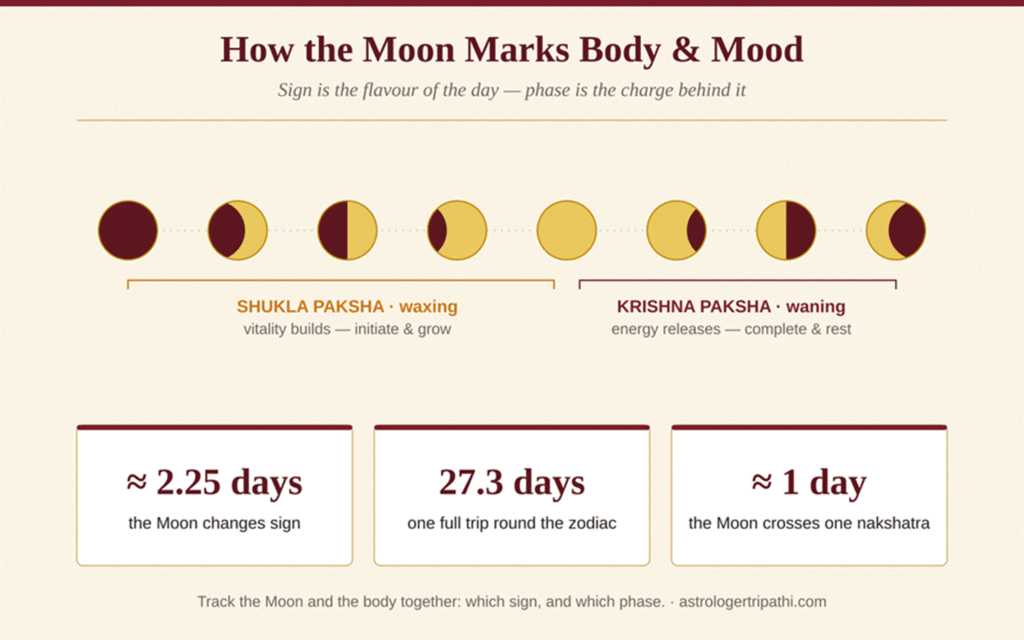
Reading the Moon and the body: sign gives the flavour of the day, phase gives the charge behind it.
Chandra and the Nervous System — The Mind–Body Bridge
In Jyotish, manas is the interface between the raw data of the senses and the deeper self. It receives, colours, and reacts — which is exactly the territory we now describe with the language of the autonomic nervous system. In Jyotish the Moon and the body are never treated as two separate problems. When the Moon is strong, well-placed, and unafflicted, that interface runs smoothly: the person is emotionally steady, adaptable, easily soothed, and able to rest. When the Moon is stressed, the same interface becomes noisy — reactive, anxious, tearful, restless, quick to lose sleep and appetite.
The elemental logic reinforces this. The Moon rules water — the tides, the sap, the fluids of the body, which make up the majority of our physical mass. Water is the medium of calm and of flow; a soothed Moon corresponds to the “rest-and-digest”, parasympathetic baseline in which the body repairs, digests, and settles. In Ayurvedic terms the Moon leans toward kapha and the nourishing rasa dhatu, the watery tissue that carries contentment through the system. This is why so much traditional Moon self-care is, at heart, nervous-system care: hydration, cooling, softening, slowing the breath, being near water, being near the mother or a nurturing presence. The ancients did not have a vagus nerve in their vocabulary, but the practices they prescribed for a troubled Moon read like a modern manual for down-regulating a hyper-aroused system.
It helps to recognise the signature of a dysregulated Moon so you can catch it early. It tends to arrive as a mind that races or loops, sleep that turns shallow or broken, a lump-in-the-throat tearfulness, an appetite that swings between craving and nothing, and a thin-skinned reactivity in which small slights land far too hard. The traditional response is never to argue the feelings away. It is to change the body’s state first — warmth, water, food, rhythm, and the presence of someone safe — and let the mind’s weather clear behind it. That is the whole philosophy of Moon care in a single line: soothe the vessel, and the waters settle.
The Moon and the Body in Modern Science
Is the bond between the Moon and the body only poetry, or is there something measurable in it? A careful word is in order first: astrology is a symbolic tradition, not a laboratory science, and the modern evidence on lunar effects is genuinely mixed and much debated. That said, chronobiology — the science of biological rhythms — has turned up findings that would not have surprised an ancient astrologer.
A tightly controlled sleep-laboratory study led by Christian Cajochen found that around the full moon, volunteers took longer to fall asleep, slept about twenty minutes less, showed a roughly thirty-percent drop in the deep-sleep brain activity that marks restorative rest, and secreted less melatonin — all without any awareness that the Moon was being studied. A later field study, published in Science Advances, tracked communities from rural Argentina to urban students and saw sleep shorten and begin later in the nights leading up to the full moon. Reviews of monthly and “circalunar” biological rhythms note that such cycles are well documented across many species and that human sleep and mood have been repeatedly proposed as candidates.
None of this “proves” astrology, and honest inquiry means holding these results loosely. But it does undercut the assumption that our forebears were simply imagining the link. When they said the Moon governs the body’s fluids, its sleep, and its moods, they were pointing at something that a sleep lab, thousands of years later, can partly measure. The old intuition and the new data rhyme, and the ancient teaching on the Moon and the body starts to look less like fancy and more like early observation.
Your Natal Moon — The Baseline Temperament
Everything so far concerns the Moon in motion. But you also carry a natal Moon — the sign and nakshatra the Moon occupied at your birth. This is your emotional constitution: the set-point your feelings return to, the things that make you feel safe, and the reflexive way you self-soothe when life presses. In Jyotish the Moon’s birth nakshatra (the Janma Nakshatra) is doubly important — it shapes your innate prakriti (nature) and it sets the starting point of your Vimshottari Dasha, the great karmic timeline that unfolds across the whole of life. This is where the Moon and the body meet your individual chart rather than the sky at large.
Two natal placements are worth remembering. The Moon is exalted in Taurus (Vrishabha, in Rohini nakshatra), where it feels most nourished and calm; and it is debilitated in Scorpio (Vrishchika), where its waters run deep, intense, and guarded. Beyond those, each Moon sign carries its own signature emotional weather. The table below is a compact field-guide — not a verdict, but a starting map for how the Moon and the body express themselves through each Rashi.
Moon Signs and Their Emotional Weather
| Moon Sign (Rashi) | Element / Nature | Emotional Weather — Body & Mood |
| Aries — Mesha | Fire · cardinal | Quick to spark and quick to cool; the body discharges feeling through movement and action. Regulates best by doing, not stewing. |
| Taurus — Vrishabha | Earth · fixed (Moon exalted) | The steadiest baseline of all; comfort-seeking, sensory, slow to anger. Soothed by food, touch, nature, and routine. |
| Gemini — Mithuna | Air · mutable | A busy, curious, talkative mind; moods ride on information and conversation. Calms through variety, words, and light contact. |
| Cancer — Karka | Water · cardinal (Moon’s own sign) | Deeply feeling and tidal; home, family, and memory are the anchor. Needs nurturing spaces to settle the nervous system. |
| Leo — Simha | Fire · fixed | Warm, generous, expressive; mood lifts with recognition and creative play, dips when unseen. Regulated by warmth and appreciation. |
| Virgo — Kanya | Earth · mutable | Analytical and service-minded; anxiety shows as over-thinking. Self-soothes by ordering, tidying, and being useful. |
| Libra — Tula | Air · cardinal | Harmony-seeking and relational; highly sensitive to conflict and imbalance. Settles through beauty, fairness, and companionship. |
| Scorpio — Vrishchika | Water · fixed (Moon debilitated) | Intense, private, all-or-nothing feeling held beneath a calm surface. Needs trust and depth; heals through catharsis. |
| Sagittarius — Dhanu | Fire · mutable | Optimistic and freedom-loving; mood thrives on meaning, travel, and space. Restless when hemmed in. |
| Capricorn — Makara | Earth · cardinal | Reserved, dutiful, self-contained; feelings are managed rather than displayed. Steadies through structure and accomplishment. |
| Aquarius — Kumbha | Air · fixed | Cool, detached, humanitarian; processes emotion through ideas and community rather than intimacy. Regulated by perspective. |
| Pisces — Meena | Water · mutable | Porous, empathic, dreamy; absorbs the moods of others and needs solitude to reset. Soothed by art, water, and rest. |
Tracking Your Transit Moon — Ancient Nervous-System Regulation
Here is where the tradition becomes a tool, and where the Moon and the body turn into a daily practice you can actually keep. Because the transit Moon (Gochar Chandra) sweeps through all twelve signs every month, it is constantly forming a fresh relationship with your natal Moon. Every two and a quarter days it lands in a new “house” counted from your birth Moon, and that placement colours the emotional tone of those days. Jyotish gives us two elegant systems for reading it.
- Chandrabala — the strength of the Moon relative to your Moon sign. Days when the transit Moon sits in the 4th, 8th, or 12th sign from your natal Moon are traditionally considered low, depleting, or unsettled; the 8th-from-Moon in particular is a classic “rest and don’t launch” day.
- Tarabala — the strength of the Moon relative to your birth nakshatra. Counting from your Janma Nakshatra, certain “taras” (notably the 3rd, 5th, and 7th in each cycle of nine) are considered challenging, while others are supportive. It is the more granular, day-by-day layer beneath the sign-level reading.
Put plainly, the ancients built a calendar of predicted nervous-system regulation. On high-Chandrabala, favourable-tara days, launch the venture, have the difficult conversation, sign the contract. On 8th-from-Moon or difficult-tara days, lighten the load, rest, hydrate, and postpone the big swing. This is precisely why classical texts advise checking the Moon before any important undertaking — a practice we explain in depth in our guide to planetary transits, Tarabala and Chandrabala. It is the clearest daily reading of the Moon and the body available to us — and, in spirit, the same thing a modern person does when they track heart-rate variability or a sleep score: reading the body’s readiness and planning around it.
When the Moon Meets Saturn — Emotional Contraction
No discussion of the Moon and the body is complete without its hardest teacher. When Saturn presses, the Moon and the body are usually the first to feel it. Saturn (Shani) is the great contractor — cooling, restricting, isolating, delaying — while the Moon wants warmth, attachment, and comfort. When the two meet by conjunction or aspect (a pattern old texts call Punarphoo or, in its harsher form, Vish Yoga), the emotional body can feel heavy, lonely, low, and prone to insomnia. Yet the same pressure, consciously worked with, forges resilience, patience, and emotional maturity. Saturn does not deny feeling; it disciplines it. Our essay on the Moon–Saturn relationship and Saturn’s deeper secrets unpacks this dynamic in detail.
This is also why Sade Sati — the roughly seven-and-a-half-year passage of Saturn through the 12th, 1st, and 2nd signs from your natal Moon — is measured from the Moon and not the Sun. It is, quite literally, a long season of Saturn pressing on the emotional body, asking it to grow up. For where Saturn currently sits and who is affected this year, see our full Saturn Transit analysis and the sign-by-sign notes in the monthly Vedic horoscope. The remedy Saturn respects is never escape — it is steady effort, honest structure, and faith held through the pressure.
Working With Your Moon — Practical Lunar Self-Care (Upaya)
Because the Moon and the body respond so quickly to care, small and consistent practices genuinely help. Traditional upaya (remedial measures) for the Moon double, almost perfectly, as nervous-system hygiene:
- Honour Monday (Somvar), the Moon’s day. Keep it a little gentler: rest more, hydrate well, wear or offer white, favour cooling white foods (milk, rice, coconut), and connect with your mother or a nurturing figure.
- Chant the Chandra mantra. “Om Shraam Shreem Shroum Sah Chandramase Namah” — traditionally 108 repetitions, ideally on Mondays or near the full moon. The slow, rhythmic breathing this requires is itself calming to the system.
- Protect sleep around the phases. Expect lighter, thinner sleep near Purnima (full moon) and a more inward, tender mood near Amavasya (new moon). Dim the lights, cool the room, and keep water by the bed.
- Tend the waters of the body. Hydration, warm nourishing foods that build rasa, time near actual water, and long, slow exhales (which switch on the parasympathetic “brake”) are all classic Moon-strengthening acts.
- Consult before gemstones. Pearl and moonstone are the Moon’s stones, but a gemstone strengthens whatever the Moon does in your chart — helpful only if the Moon is well-placed for you. Have your chart read before wearing one; never self-prescribe.
- Keep a Moon-and-mood journal. A single line a day — the Moon’s current sign and how your body and feelings ran — quickly reveals your personal pattern.
A Simple Four-Step Lunar Body–Mood Practice
If you do nothing else with this article, try the following short experiment in reading the Moon and the body. It turns the whole tradition into a personal, evidence-gathering habit that maps the Moon and the body onto your own life — a regulation log built one lunar cycle at a time.
- Learn your baseline. Find your natal Moon sign and Janma Nakshatra (an accurate birth time is essential). This is the constitution everything else is measured against.
- Watch the transit Moon for one full cycle. Each morning, note the Moon’s current sign and a one-line reading of your body and mood. Over about 27 days you will start to see the correlations for yourself.
- Plan around your low and high days. Reserve demanding tasks for high-Chandrabala, favourable-tara days; on 8th-from-Moon or difficult days, deliberately lighten the load and rest.
- Run your Moon-care ritual on Mondays and at the phases. Hydrate, slow the breath, chant if you wish, and journal. Repeat over a few cycles and you will hold a genuine map of your own inner tides.
Listening to the Moon Within
The Moon’s great gift is immediacy. Where the slow planets describe the long arc of a destiny, the Moon reports on today — on the body you actually live in and the mood you actually carry. Hellenistic physicians read it in the humours; Vedic seers read it as manas and rasa; a modern sleep lab reads it in melatonin and delta waves. Across every one of these languages, the Moon and the body are treated as a single, living system, and the message is the same: pay attention to your Moon, and you are paying attention to yourself.
Tracking the Moon and the body together will not remove life’s storms, but it will let you meet them with more grace — resting when the tide is low, acting when it is high, and treating your own nervous system with the tenderness it deserves. To have your natal Moon, nakshatra, and current transits read with care, explore more Cosmic Insights on our astrologertripathi.com blog or reach out for a personal consultation with Dr. A. K. Tripathi. The Moon within you has been keeping time all along. It is worth learning to listen.
Frequently Asked Questions
What does the Moon represent in Vedic astrology?
In Jyotish the Moon, or Chandra, signifies manas (the feeling, sensing mind), the mother, the emotions, bodily fluids and nourishment, and general wellbeing. It is so important that charts are often read from the Moon (the Chandra Lagna), and your Moon sign (Rashi) is what most people in India mean by “their sign.” In short, Chandra is the karaka of the Moon and the body.
How often does the Moon change signs?
About every two and a quarter days. The Moon completes the entire zodiac in roughly 27.3 days, moving through one of the 27 nakshatras in a little under a day. This makes it the fastest-moving body in astrology and the natural marker of day-to-day mood.
Can the Moon really affect mood and sleep?
Astrology is a symbolic tradition rather than a proven science, and the evidence is genuinely mixed. That said, controlled sleep studies have observed reduced deep sleep and lower melatonin around the full moon, and chronobiology recognises “circalunar” rhythms across many species. The ancient intuition and the modern data at least rhyme on the question of the Moon and the body.
What is the difference between my Moon sign and Sun sign?
Your Sun sign reflects your core identity, will, and vitality; your Moon sign reflects your emotional nature, instincts, and the body’s baseline. In Vedic astrology the Moon sign usually carries more weight for temperament, timing, and daily prediction.
How do I start tracking my transit Moon?
First learn your natal Moon sign and nakshatra from an accurate birth chart. Then note the Moon’s current sign each day alongside your mood for one full cycle. Over about a month you will see which placements feel supportive and which feel draining — the essence of the Tarabala and Chandrabala systems.

